
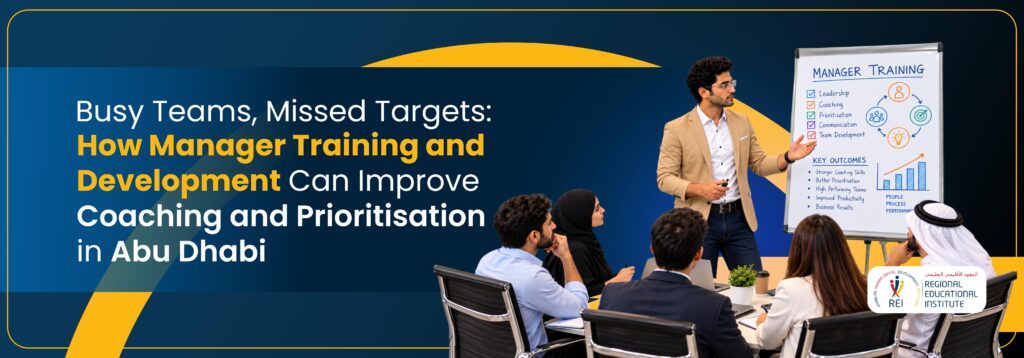
Why do busy teams miss targets?
Poor prioritisation, weak delegation and limited coaching may be the culprits. Discover how REI’s MDP can transform everyday management into measurable progress.
A team can spend an entire day working at full capacity and still finish without completing its most important tasks. In fact, the problem may not be a lack of effort, but a lack of direction.
Managers in Abu Dhabi handle multiple projects, changing client expectations, competing deadlines and teams that need continuous guidance. The difference between being busy and being productive must be analysed systematically. Moreover, manager training and development in Abu Dhabi becomes highly valuable here. Clearly, activity alone does not guarantee progress towards business objectives. Only 44% of managers globally have ever received management training (Source: Gallup).
Generally, a manager’s role lies in translating organisational targets into clear priorities, allocating responsibilities and helping employees overcome obstacles. Ultimately, prioritisation, coaching and delegation as well as constructive feedback are the three essential capabilities that modern managers need.
When priorities are unclear, even capable employees can spend their energy on the wrong tasks. So, understanding how this happens is the first step towards improving team performance.
The Hidden Impact of Poor Prioritisation on Team Productivity and Deadlines
When every task is labelled urgent, teams lose the ability to recognize what genuinely matters.
It may be difficult for managers to differentiate between urgent tasks and those that add value towards achieving organisational objectives. Also, workers can move back and forth between their emails, meetings, customer requests and project work. This becomes a challenge for focusing. In addition, when managers keep shifting their focus without reason, workers may end up duplicating work. 98.2% of people report difficulty prioritising tasks (Source: Reclaim.ai).
Also, poor delegation can leave managers overloaded with operational tasks while strategic decisions remain unattached. This eventually leads to a ripple effect. That is, unclear priorities lead to delayed decisions, bottlenecks, rushed work and last-minute corrections. Additionally, it may create issues in client commitments, interdepartmental coordination, service quality and team morale. Leadership training for managers becomes relevant here.
So what are the practical prioritisation methods?
Rank tasks by business impact, urgency, dependencies and deadlines.
Break down large deliverables into milestones each with an owner and deadline.
Use weekly planning, daily prioritisation meetings and group task management for visibility.
Get managers to re-prioritise given any changes in customer requirements/conditions.
However, a simple task list is not enough for prioritisation which needs proper planning and communication. Moreover, effective learning can enable managers to learn ways of scheduling and organising tasks effectively. REI’s courses in leadership and management provide clear learning pathways.
Most importantly, setting priorities creates direction but it alone is insufficient. Managers must also help employees understand their responsibilities, build confidence and deliver the expected results.
Lead your team with greater clarity and confidence. Explore REI’s MDP course.
Call us at 054-5323292 or write to us at info@rei.ae.
How Coaching, Delegation and Constructive Feedback Improve Team Performance
Certainly, effective managers do more than distribute work. They create the conditions that allow people to complete it well.
Coaching: Develop capability, not dependency
Through coaching, employees will be able to analyse difficulties without constantly relying on managers for every decision. In addition, it will allow managers to pose questions, establish goals and highlight skill deficiencies.
For example, rather than simply correcting a delayed report, a manager who attends courses leadership management can discuss the obstacles with the employee and agree on a realistic action plan.
Delegation: Match responsibility with capability
Mainly, delegation comprises allocating responsibility, authority, deadlines and expected outcomes. The manager is supposed to allocate jobs according to the abilities and experience of the employees. Besides, proper delegation helps in avoiding managerial bottlenecks and offers opportunities for the development of employees. Effective delegation can free roughly 24% of a manager’s time (Source: Harvard Business Review)
Most importantly, delegation is not simply transferring unwanted work. Managers remain responsible for providing guidance and monitoring progress. Leadership and management training will be helpful to learn this.
Constructive feedback: Turn performance gaps into action
Managers can recommend timely, specific, and behavior-focused feedback rather than vague criticism. Also address achievements against the set goals, identify areas for improvement and determine actionable next steps. Moreover, facilitate a two-way communication process, allowing employees to voice their concerns on issues such as resource availability, deadlines or confusing instructions.
While prioritisation establishes what matters, delegation clarifies ownership, coaching builds capability and feedback maintains alignment. Furthermore, REI’s manager training and development in Abu Dhabi is structured in a way to build these capabilities in professionals.
Building Practical Management Skills Through REI’s Management Development Program
Strong management is not simply about knowing what a good leader should do. It is about making sound decisions when deadlines tighten, priorities shift and teams need direction.
REI’s MDP course is designed for aspiring managers, professionals in managerial positions and middle managers preparing for greater responsibilities. It is a way to strengthen practical leadership, people management, decision making and workplace problem solving capabilities. In addition, these skills are relevant to managers handling competing priorities and team performance expectations in Abu Dhabi.
Our manager training and development in Abu Dhabi comes with structured modules and flexible learning methods. This 20-hour course gives managers clear insights about task ownership, more considered decisions, better time management and constructive employee conversations.
We know that training can equip managers with skills and techniques, but the outcomes depend on how consistently those skills are applied at work. As a training institute, we build professionals who can move beyond reacting to daily pressures and begin building teams that work towards shared outcomes.
Lead your team with greater clarity and confidence. Explore REI’s MDP course.
Call us at 054-5323292 or write to us at info@rei.ae.
FAQ
What can managers in Abu Dhabi do to increase productivity and stay on schedule?
By focusing on priorities, allocating duties based on the strengths of employees, monitoring their performance and giving feedback on time, managers can enhance productivity in Abu Dhabi. Proper management training can aid managers in managing tasks effectively.
How do I benefit from REI’s Management Development Program in Abu Dhabi?
REI’s Management Development Program includes all those topics that are related to the practical aspects of management, including planning, organising, delegation, time management, coaching, feedback, motivation and decision-making.
Who should enroll in management development program in Abu Dhabi?
The management development program would be ideal for future managers, team leaders, middle managers and professionals who wish to undertake the challenge of becoming managers. These classes could aid in building practical knowledge of communication, decision-making, workload management and human resource development.
How does leadership training assist managers in dealing with conflicting deadlines?
Through leadership training, managers will be able to determine the importance of tasks, prioritise the allocation of resources and create realistic schedules. This will help in ensuring that projects are in line with organisational goals.
How many hours is the REI Management Development Program, and what certification do they provide?
The REI Management Development Program lasts 20 hours, which can be taken either online or offline. It provides dual certification by CPD-UK and ACTVET Abu Dhabi. Interested individuals are advised to visit the course website for more information.